Posts
Posts




At first, I didn’t recognize the place. Read the entire article. There is much more.
NYT reporter, Dexter Filkins, returns to Iraq for the first time since the height of sectarian violence in 2006, the year before General Petraeus implemented the counterinsurgency strategy. He is stunned at what he finds. Ironically, it can be summed up as hope and change.
___________________________________________________
This from Mr. Filkins writing in the NYT:
On Karada Mariam, a street that runs over the Tigris River toward the Green Zone, the Serwan and the Zamboor, two kebab places blown up by suicide bombers in 2006, were crammed with customers. Farther up the street was Pizza Napoli, the Italian place shut down in 2006; it, too, was open for business. And I’d forgotten altogether about Abu Nashwan’s Wine Shop, boarded up when the black-suited militiamen of the Mahdi Army had threatened to kill its owners. There it was, flung open to the world.
Two years ago, when I last stayed in Baghdad, Karada Mariam was like the whole of the city: shuttered, shattered, broken and dead.
Abu Nawas Park — I didn’t recognize that, either. By the time I had left the country in August 2006, the two-mile stretch of riverside park was a grim, spooky, deserted place, a symbol for the dying city that Baghdad had become.
These days, the same park is filled with people: families with children, women in jeans, women walking alone. Even the nighttime, when Iraqis used to cower inside their homes, no longer scares them. I can hear their laughter wafting from the park. At sundown the other day, I had to weave my way through perhaps 2,000 people. It was an astonishing, beautiful scene — impossible, incomprehensible, only months ago.
When I left Baghdad two years ago, the nation’s social fabric seemed too shredded to ever come together again. The very worst had lost its power to shock. To return now is to be jarred in the oddest way possible: by the normal, by the pleasant, even by hope. The questions are jarring, too. Is it really different now? Is this something like peace or victory? And, if so, for whom: the Americans or the Iraqis?
. . . When I left Iraq in the summer of 2006, after living three and a half years here following the collapse of Saddam Hussein’s regime, I believed that evil had triumphed, and that it would be many years before it might be stopped. Iraq, filled with so many people living so close together, nurturing dark and unknowable grievances, seemed destined for a ghastly unraveling.
And now, in the late summer of 2008, comes the calm. Violence has dropped by as much as 90 percent. A handful of the five million Iraqis who fled their homes — one-sixth of all Iraqis — are beginning to return. The mornings, once punctuated by the sounds of exploding bombs, are still. Is it possible that the rage, the thirst for revenge, the sectarian furies, have begun to fade? That Iraqis have been exhausted and frightened by what they have seen?
“We are normal people, ordinary people, like people everywhere,” Aziz al-Saiedi said to me the other day, as we sat on a park bench in Sadr City, only recently freed from the grip of the Mahdi Army. The park was just a small patch of bare ground with a couple of swing sets; it didn’t even have a name, yet it was filled to the bursting. “We want what everyone else wants in this world,” he said.
. . . Everything here seems to be standing on its head. Propaganda posters, which used to celebrate the deaths of American soldiers, now call on Iraqis to turn over the triggermen of Al Qaeda in Mesopotamia and the Mahdi Army. “THERE IS NOWHERE FOR YOU TO HIDE,” a billboard warns in Arabic, displaying a set of peering, knowing eyes. I saw one such poster in Adamiyah, a Sunni neighborhood that two years ago was under the complete control of Al Qaeda. Sunni insurgents — guys who were willing to take on the Qaeda gunmen — are now on the American payroll, keeping the peace at ragtag little checkpoints for $300 a month.
In Sadr City, the small brick building that served as the Mahdi Army’s headquarters still stands. But not 50 feet away, a freshly built Iraqi Army post towers above it now. Next to the army post, perhaps to heighten the insult to the militia, the Iraqi government has begun installing a new sewer network, something this impoverished and overcrowded ghetto sorely needs. “Wanted” posters adorn the blast walls there, too, imploring the locals to turn in the once-powerful militia leaders.
Inside the Sadr Bureau, as it’s called, the ex-militia gunmen speak in chastened tones about moving on, maybe finding other work, maybe even transforming their once ferocious army into a social welfare organization. I didn’t see any guns.
“Please don’t print my name in your newspaper,” one former Mahdi Army commander asked me with a sheepish look. “I’m wanted by the government.”
As for the Americans, they are still here, of course, but standing ever more in the background.
. . . The other day I rode in a helicopter to Ramadi, the capital of Anbar Province, the Wyoming-size slice of desert west of Baghdad. Two years ago, 30 marines and soldiers were dying there every month. In 2005, Al Qaeda in Mesopotamia declared Anbar the seat of its “caliphate.” Since then, violence in Anbar has plummeted. Al Qaeda has been decimated. I was coming in for a ceremony, unimaginable until recently, to mark the handover of responsibility for security to the Iraqi Army and police.
Standing in the middle of the downtown, I found myself disoriented. I had been here before — I was certain — but still I couldn’t recognize the place. Two summers ago, when I’d last been in Ramadi, the downtown lay in ruins. Only one building stood then, the Anbar provincial government center, and the Americans were holding onto it at all cost. For hundreds of yards in every direction, everything was destroyed; streets, buildings, cars, even the rubble had been ground to dust. Ramadi looked like Dresden, or Grozny, or some other obliterated city. Insurgents attacked every day.
And then, suddenly, I realized it: I was standing in front of the government center itself. It was sporting a fresh concrete facade, which had been painted off-white with brownish trim. Over the entrance hung a giant official seal of Anbar Province. The road where I stood had been recently paved; it was black and smooth. The rubble had been cleared away. American marines were walking about, without helmets or flak jackets or even guns.
In the crowd, I saw a face I recognized. It was Mowaffak al-Rubaie, Iraq’s national security advisor. It had been a long time since I’d seen him. Mr. Rubaie is a warm, garrulous man, a neurologist who spent years in London before returning to Iraq. But he is also a Shiite, and a member of Iraq’s Shiite-led government, which, in 2005 and 2006, was accused of carrying out widespread atrocities against Iraq’s Sunnis. Anbar Province is almost entirely Sunni.
As Mr. Rubaie made his way through the crowd, I noticed he was holding hands with another Iraqi man, a traditional Arab gesture of friendship and trust. It was Brig. Gen. Murdi Moshhen al-Dulaimi, the Iraqi Army officer taking control of the province — a Sunni. The sun was blinding, but Mr. Rubaie was wearing sunglasses, and finally he spotted me.
“What on earth are you doing here?” he asked over the crowd.
I might have asked him the same thing.
. . . In August, before I came back to Iraq, I visited Gen. Ray Odierno in his office at the Pentagon. As the deputy commander in Iraq from late 2006 to early 2008, General Odierno had helped execute the buildup of American troops that has helped quell the violence. When we met, he was preparing to assume command of the American forces here, taking over for Gen. David H. Petraeus.
General Odierno, an enormous, imposing man, has come a long way in Iraq.
. . . When he returned to Iraq in late 2006, General Odierno concluded that the American project in Iraq was headed for defeat. The American officers whom he was replacing had reached the same conclusion. “I knew that if we continued the way that we were, then we were not going to be successful,” he said.
Hence the troop increase. At its most basic level, General Odierno explained, the premise of this “surge” was that ordinary Iraqis didn’t want the violence. That is, that the chaos in Iraq was being driven by small groups of killers, principally those of Al Qaeda in Mesopotamia, who, by murdering Shiite civilians in huge car and suicide bomb attacks, were driving ordinary Iraqis into the arms of Shiite deaths squads and the Mahdi Army. If that dynamic could be broken, ordinary Iraqis would stop relying on militias to protect them. Something approaching normalcy might return.
“We believed that the majority of the Iraqi people wanted to move forward, but you had these small groups that didn’t,” General Odierno said. “So we had to protect the people, and go after these groups.”
And so they did, with a series of offensives against the Qaeda insurgents in and around Baghdad in 2007 and then, earlier this year, in Basra and in Baghdad against the Mahdi Army. Along the way, the Americans got a huge break: The leaders of Iraq’s large Sunni tribes, which had included many insurgents, decided to stop opposing the Americans and join them against Al Qaeda. The Americans, seizing the opportunities, agreed to put many of the tribesmen, including many former insurgents, on the payroll.
The Sunni Awakening, as it is called, cascaded through Sunni areas across Iraq.
The result, now visible in the streets, is a calm unlike any Iraq has known in the five and a half years since the Americans arrived. Iraqi life is flowing back into the streets. The ordinary people, the “normal people,” as Mr. Aziz called them, have the upper hand, at least for now. . . .
The forces arrayed against Iraq are significant. Iran has been beaten back - but only for the moment. Al Qaeda's defeat has been more significant, though it to could theoretically stage a come back. Corruption is endemic. Massive oil wealth is a blessing and a curse, increasing the wealth of the nation even as many eye a way to get their hands on an ill-gotten piece of the wealth. The Kurdish north is doing its best to take control of the oil fields near Kirkuk and to become a defacto separate country, threatening to tear Iraq apart.
Arrayed against those forces are a nation desperate to live in peace. It is a nation of intelligent and hardworking people with a history of intermixing between Sunni, Shia and Kurd. It is a nation that is hopeful of democracy to give it good and fair government. And Iraq still has a U.S. partner committed - for the moment - to seeing Iraq a success. Whatever the future may hold, for now, there is a hardwon peace.
Showing posts with label counterinsurgency. Show all posts
Showing posts with label counterinsurgency. Show all posts
Sunday, September 21, 2008
State of Iraq - What The Surge Hath Wrought

Wednesday, July 23, 2008
McCain, The Anbar Awakening, & Intellectual Honesty At MSNBC
McCain, in a statement yesterday, stated that the surge was responsible for the Anbar Awakening. Though the Anbar Awakening was solicited by the U.S. - and indeed, soliticing popular support is at the heart of counterinsurgency strategy - it actually got its start in September, 2006, three months before the formal adoption of the counterinsurgency strategy. In any event, the Anbar Awakening was fully supported by the surge and was, as part of the counterinsurgency, used as the model to spread throughout the rest of Iraq.
The left has been swarming on this one, claiming McCain does not know what he is talking about because the Awakening technically started before the surge. Joe Scarborough and former Democratic Senatorial candidate Harold Ford Jr. put this one in brutal perspective.
I may have to start watching Mr. Scarborough. (Video from Olbermann Watch)
Below
Iraq Speech Part I: Obama Tosses Our Military Under The Bus To Defend His Poor Judgment (Updated)
Obama's latest ploy is to claim that his judgement in opposing the surge was not poor because: . . . With respect to the surge, you know, we don't know what would have happened if I -- if the plan that I put forward in January 2007 to put more pressure on the Iraqis to arrive at a political reconciliation, to begin a phased withdrawal, what would have happened had we pursued that strategy. Read the entire transcript. Just when one thinks that Obama has plumbed the depths of political cynicsm, he hits a new low. Obama's attempt to take away credit from U.S. forces and denigrate their achievement, their sacrifice and the brilliance of their command is the lowest he has gotten - so far. And to claim that no one could forsee what would have happened had we followed his plan to withdraw immediately in 2007 is just ridiculous.
1. No one could have foreseen the rise of the Anbar Awakening movements, and it was these movements that played a large role in the success we see today in Iraq.
2. No one could have foreseen the simultaneous "cease fire" by Sadr, an act taken apparently unilaterally and with no relationship to U.S. combat actions.
3. The two events above are what truly have led to security in Iraq, with the "surge" of U.S. forces being an ancillary factor.
[Update: The videos that were here are now replaced by quotes from the transcript. The videos became non-operational after RedLasso was forced to cease operations by a lawsuit - another MSM attack on bloggers and rights of fair use.]
This from the NYT Transcripts of the Obama's speech & Q&A session:
I am pleased that as a consequence of great effort by our troops, but also as a consequence of a shift in allegiances among the Sunni tribal leaders as well as the decision of the Sadr militias to stand down, that we've seen a quelling of the violence.
. . . Second question was how would I apportion the improvements in Iraq. I don't know how to put a numerical factor on that. There is no doubt that when we put in 30,000 American troops, here is no doubt that when we put in 30,000 American troops, who are dedicated, who are brave, and who bring extraordinary skill to their jobs, that they're going to make a difference.
I think the commanders on the ground themselves would -- would acknowledge that, had you continued to see Sunni leadership align itself with AQI, that we would be in a different situation right now. That if you continued to see ethnic cleansing in Baghdad or the Sadr militias continuing to engage in some of that activity and constant reprisals, that you'd still have some big problems there right now.
But I don't know how to put a numeric -- you know, a number to that.
As I wrote yesterday, on the day the surge was announced, al Qaeda controlled practically all of the Sunni provinces and Iran through its proxies had a stranglehold on the South. Just how hard is it to assess where Iraq would be today if we had not challenged those situations militarily? One need engage in no speculation to make such an assessment.
How does Obama think the Anbar Awakening started? This didn't come about magically. U.S. forces solicited it from its very inception. It actually coallesced in September, 2006 and was well known - even the NYT was writing about its success by April, 2007. Does Obama think that the creation, survival or spread was unrelated to the surge?
Why does Obama think that Sadr left Iraq for Iraq in January, 2007 and all of his Mahdi Army suddenly dropped below the radar screen? A large part of the justification for the surge was to stop the militia attacks. In 2004 and 2005, the U.S. had decimated the Mahdi Army. They damn well knew what was coming in the surge if they tried to continue their operations to Lebanize Iraq.
The only way Obama can defend his judgment is by falsely minimizing the success of U.S. forces. The fact that he has chosen to do so tells you even more about just how partisan and warped his judgment truly is.
Update: Joe Scarborough and Harold Ford Jr. respond not to Obama, but the argument he is in essence making that the Awakening Movements and their success was unrelated to the surge. It is brutal:
Friday, January 18, 2008
Al Qaeda, Current Ops in Iraq, & Security In Baghdad
 The map above shows in dark red the remaining areas where al Qaeda is still active in Iraq. The light areas indicate transit routes. This today from the Long War Journal:
Nearly one year to the day of the announcement of the "surge" of US forces to Iraq and the change in counterinsurgency plan, Iraqi and Coalition forces have shrunk al Qaeda's ability to conduct operations inside Iraq, a senior US commander said.
During a press briefing in Baghdad, Lieutenant General Ray Odierno, the Commander of Multinational Corps Iraq, said al Qaeda in Iraq has been ejected from its strongholds in the cities to the rural regions of Iraq.
From late 2006 into 2007, "Iraq was caught in a cycle of bloodshed under the dark cloud of al Qaeda," said Odierno. Al Qaeda was "entrenched in numerous urban safe havens across Iraq" until the surge forces launched Operation Phantom Thunder in June 2007.
Al Qaeda in Iraq's network has been significantly degraded, but is still a threat. Al Qaeda remains active in regions near Miqdadiyah, Mosul, Hawijah, Samarra, and southeast of Baghdad in the Arab Jabour region. "Although the group remains a dangerous threat, its capabilities have been diminished," said Odierno. "Al Qaeda has been pushed out of urban centers like Baghdad, Ramadi, Fallujah and Baqubah, and forced into isolated rural areas. Many of their top leaders have been eliminated, and finding qualified replacements is increasingly difficult for them." Multinational Forces Iraq also estimates it has significantly degraded al Qaeda's ability to fund operations by dismantling its financier networks and leaders.
Operation Phantom Phoenix, the current nationwide operation targeting al Qaeda's remaining safe havens, was launched on Jan. 8. Iraqi and US forces have captured or killed 121 al Qaeda fighters, wounded 14, and detained an additional 1023 suspects. Al Qaeda's leadership has been hit hard during the operation, with 92 high values targets either killed or captured.
Iraqi and US forces have also discovered 351 weapons caches and four tunnel complexes, Odierno said. Iraqi and US forces have also discovered three car bomb and improvised explosive device [IED] factories and 410 IEDs, including 18 car bombs and 25 homes rigged with explosives. Also found were "numerous torture chambers, an underground medical clinic, several closed schools, and a large foreign fighter camp with intricate tunnel complexes," said Odierno. . .
Read the entire post here. The USA Today uses its front page today to highlight the dramatic security gains in Iraq made with the counterinsurgency strategy:
About 75% of Baghdad's neighborhoods are now secure, a dramatic increase from 8% a year ago when President Bush ordered more troops to the capital, U.S. military figures show.
The military classifies 356 of Baghdad's 474 neighborhoods in the "control" or "retain" category of its four-tier security rating system, meaning enemy activity in those areas has been mostly eliminated and normal economic activity is resuming.
The data given by the military to USA TODAY provide one of the clearest snapshots yet of how security has improved in Baghdad since roughly 30,000 additional American troops arrived in Iraq last year.
U.S. commanders caution that the gains are still fragile, but at the moment U.S. and Iraqi forces "basically own the streets," said Col. Ricky Gibbs, a brigade commander in southern Baghdad.
The fight to control Baghdad is the centerpiece of the counterinsurgency strategy launched a year ago by Gen. David Petraeus, the commander of U.S. forces in Iraq. The plan, popularly known as the "surge," seeks to reduce sectarian and other violence by moving troops off large bases and into dangerous neighborhoods to protect civilians.
The 310 neighborhoods in the "control" category are secure, but depend on U.S. and Iraqi military forces to maintain the peace. The 46 areas in the "retain" category have reached a level where Iraqi police and security forces can maintain order, a more permanent fix. The remaining areas have fewer security forces based there, though they are not necessarily violent.
In February 2007, when additional U.S. forces began arriving, only 37 Baghdad neighborhoods were in the "control" and "retain" categories.
The drop in violence in Baghdad and elsewhere helped avert a religious civil war, said Thomas Hammes, a retired Marine colonel and author.
. . . The U.S. military is wary of handing over security responsibility too quickly to Iraqi forces. "There are concerns we'll pull out of here too fast just because we have such great gains," Gibbs said by phone from Iraq.
. . . Although weakened and pushed out of Iraq's major cities, al-Qaeda remains focused on trying to dominate the capital, Lt. Gen. Raymond Odierno, the No. 2 U.S. commander in Iraq, said Thursday. "Their long-term sights are still set on Baghdad," he said.
Read the entire article here.
Wednesday, December 19, 2007
A Tale of Two Iraqs & Two Wars
 Retired LTG McCaffrey, now on the academic staff at West Point, has been making ongoing assessments of the situation in Iraq for several years. He has been portrayed by some as overly critical and, indeed, labeled a "Bush basher." I think that a simplistic characterization, though admittedly he is one who tends to see the glass half empty and he has long displayed a visceral dislike for former Sec. of Defense Don Rumsfeld.
McCaffrey has never made an attempt to sugar coat his assessments, though he obviously wants to see our efforts in Iraq succeed. His is a very rare and honest perspective that, combined with his military background, you cannot find elsewhere in the MSM. In this light, it is worthwhile to compare his earlier assessment of Iraq released during the dark days of March 2007, just as our new counterinsurgency statregy was being implemented (here), with his current report (here), as well as to look at these assessments of the Iraq War within the larger context of the "war on terror."
McCaffrey, in March, perceived Iraq to be caught up in a low level civil war that showed every promise of getting worse. He wrote: "[T]his whole Iraq operation is on the edge of unraveling as the poor Iraqis batter each other to death with our forces caught in the middle." He now sees the situation changed dramatically, and is obviously frustrated by those who, for political reasons, want to see Iraq fail:
The struggle for stability in the Iraqi Civil War has entered a new phase with dramatically reduced levels of civilian sectarian violence, political assassinations, abductions, and small arms/ indirect fire and IED attacks on US and Iraqi Police and Army Forces.
This is the unmistakable new reality ---and must be taken into account as the US debates its options going forward. The national security debate must move on to an analysis of why this new political and security situation exists---not whether it exists.
McCaffrey may as well as have been addressing his statements directly to Harry Reid, who only yesterday boldly claimed that al Qaeda in Iraq was resurgent and that America was once again losing.
McCaffrey assesses that the Iraqi central government is broken and the Iraqi Constitution unworkable, though unfortunately he does not expound upon those observations. That said, McCaffrey perceives that Iraq is developing effective governance at the grass roots level and that it is "is entirely credible that a functioning Iraqi state will slowly emerge from the bottom up." That proposition is of particular importance to the current debate on Iraq. Harry Reid aside, those Democrats who still seek to legislate withdrawal from Iraq do so on the justification that the Iraqi government has failed to enact the "benchmarks" that would allow for an effective government. If McCaffrey is accurate in his assessment, yes, the government is broken, and yes, top down imposition of the "bench marks" is unlikely to occur, but ultimately, it doesn't matter. This needs to inform the debate on how to go forward in Iraq.
It is curious that McCaffrey still characterizes what is occurring in Iraq as a "civil war," a defined term in the military lexicon based on specific conditions that do not seem to exist in Iraq today. Certainly there is the possibility that such could occur, but given the huge decrease in violence and the role of Iran in fomenting violence, this label, standing alone, seems arguably wrong and pretty clearly simplistic. Unfortunately, while he applies this label, he does not provide justification.
McCaffrey sees the development of professional Iraqi security forces and police as the lynchpin of creating a stable Iraq. In March, what he observed seemed hopeless:
The police force is feared as a Shia militia in uniform which is responsible for thousands of extra-judicial killings. There is no effective nation-wide court system. There are in general almost no acceptable Iraqi penal institutions. The population is terrorized by rampant criminal gangs involved in kidnapping, extortion, robbery, rape, massive stealing of public property ---such as electrical lines, oil production material, government transportation, etc. (Saddam released 80,000 criminal prisoners.)
The Iraqi Army is too small, very badly equipped. . . The Iraqi Army is also unduly dominated by the Shia, and in many battalions lacks discipline. There is no legal authority to punish Iraqi soldiers or police who desert their comrades. (The desertion/AWOL numbers frequently leave Iraqi Army battalions at 50% strength or less.)
Today, McCaffrey sees the situation significantly changed:
The Iraqi Security Forces are now beginning to take a major and independent successful role in the war. Under the determined leadership of LTG Jim Dubik ---both the equipment and force levels of the Iraqi Security Forces are now for the first time in the war at a realistic level of resource planning.
The previously grossly ineffective and corrupt Iraqi Police have been forcefully re-trained and re-equipped. The majority of their formerly sectarian police leadership has been replaced. The police are now a mixed bag--- but many local units are now effectively providing security and intelligence penetration of their neighborhoods. . . .
If all else were to remain unchanged, it would seem that Iraq is on a forward trajectory to a peaceful, functional society in the foreseeable future. There are two major wildcards. One is the influence of Iran that McCaffrey only touches upon briefly in his report. The other is one that has been just below the surface for years. That is the problem of the Kurdish north.
Under our umbrella of protection after the first Gulf War, the Kurds became a separate country and, after the fall of Saddam, made clear that they had no desire to reintegrate into a larger Iraq. They have tried to stay out of the ambit of national laws, attempted to exercise control over oil assets in the north - including the passage of their own hydrocarbon laws in August in direct opposition to the Iraq central government - and manuevered to take control of Kirkuk and Mosul. They have played against our efforts over the past several years to create a united Iraq, and, as McCaffrey notes, the Kurdish north could easily become the next major battleground:
The Kurds are a successful separate autonomous state – with a functioning and rapidly growing economy, a strong military (Both existing Pesh Merga Forces and nominally Iraqi-Kurdish Army divisions), a free press, relative security, significant foreign investment, and a growing tourist industry which serves as a neutral and safe meeting place for separated and terrified Sunni and Shia Arab families from the south.
There are Five Star hotels, airline connections to Europe, a functioning telephone system, strong trade relations with Syria, enormous mutually beneficial trade relations with Turkey, religious tolerance, a functional justice system, and an apparently enduring cease-fire between the traditional Kurdish warring factions.
Kurdish adventurism and appetite to confront both their external neighbors and the Iraqi central state may have been tempered in a healthy way by the prospect of invasion from the powerful Turkish Armed Forces to avenge the continued cross-border KKP terrorism.
The war-after-next will be the war of the Iraqi Arabs against the Kurds ---when Mosul as well as Kirkuk and its giant oil basin (and an even greater Kurdish claimed buffer zone to the south) is finally and inevitably absorbed (IAW the existing Constitution) by the nascent Kurdish state. The only real solution to this dread inevitability is patient US diplomacy to continually defer the fateful Kurdish decision ad infinitum.
David Ignatius has a good column on this issue in the Washington Post.
There can be little doubt that what has occurred over the past 48 hours goes to the heart of this issue. Approximately two days ago, the U.S. provided actionable intelligence to Turkey as to PKK locations. Turkey subsequently engaged those PKK elements by air and with cross border raids. If the Kurds harbored any illusions that we might remain neutral while they brought Iraq back into open warfare in order to satisfy their separatist aspirations, they should be disabused of those beliefs now. This is a major problem that will not go away soon, but it is one that we absolutely must contain.
McCaffrey sees a need for a long term U.S. presence in Iraq as is currently being negotiatiated between Bush and Maliki. He sees this necessary both to stabilize the nascent Iraqi government and to "hold at bay Iraq’s neighbors from the desperate mischief they might cause that could lead to all out Civil War with regional involvement." Its hard to underestimate the importance of maintaining bases in Iraq. After the recent NIE removed the justification for using force against Iran as to its nuclear program, maintaining forces in Iraq may be our only option to provide some check on Iran's regional aspirations towards its neighbor. Yet this is another area that our far left - including our Democratic Presidential candidates - are contesting.
McCaffrey’s report contains numerous other observations, some promising, some highly troubling - all well worth your read. As to a final note here, in March, McCaffrey wrote of al Qaeda in Iraq and the Shia insurgency:
Iraq is ripped by a low grade civil war which has worsened to catastrophic levels with as many as 3000 citizens murdered per month. The population is in despair. Life in many of the urban areas is now desperate. A handful of foreign fighters (500+) --- and a couple of thousand Al Qaeda operatives incite open factional struggle through suicide bombings which target Shia holy places and innocent civilians. Thousands of attacks target US Military Forces (2900 IED’s) a month---primarily stand off attacks with IED’s, rockets, mortars, snipers, and mines from both Shia (EFP attacks are a primary casualty producer) ---and Sunni (85% of all attacks---80% of US deaths—16% of Iraqi population.)
In his current assessment, McCaffrey states that al Qaeda in Iraq has been defeated "tactically and operationally" - that's military speak for 'wiped out as a functioning force.' Further, McCaffrey observes that "[t]he senior leaders of AQI have become walking dead men because of the enormous number of civilian intelligence tips coming directly to US Forces." (Update: See this post at Gateway Pundit discussing our recent successes against al Qaeda's leadership) McCaffrey explains that al Qaeda was broken by a mix of exceptional soldiering and diplomacy by our combat forces wearing two hats and the fact that al Qaeda was far too fanatical and insufficiently nationalistic for the vast majority of Iraq's Sunnis. All that said, McCaffrey observes that al Qaeda is attempting to "reconstitute along the Syrian border."
McCaffrey does not address what possibility there exists for a reconstituted al Qaeda to regain a foothold in Iraq as U.S. forces inevitably stand down. It would seem small indeed given that al Qaeda has lost virtually all support among Iraq's Sunni population and given that Iraqi security forces are beginning to become efficient and capable.
That said, while Iraq has been a great defeat for al Qaeda, al Qaeda is hardly defeated. Because al Qaeda is an amorphous threat centered upon the Salafi / Wahhabi religious ideal, it will forever replicate until the idea is itself altered or defeated. Our military in foreign lands and our national security personnel at home have been tasked with meeting the immediate threat of al Qaeda and its ideological brethern. Both our military and our national security personnel have been incredibly successful, but at a great cost in national treasure and in blood.
The problem is that defeating the immediate threat, while an absolute necessity, will not end the long term threat. Like some nightmare phoenix, al Qaeda and their ideological brethern who would act to impose Islam on the world will continue to arise from their own ashes so long as that which animates them – i.e., the "radical" religious ideals that comprise Wahhabi / Salafi Islam – go unchecked.
If we are able to build and sustain some semblance of a free and democratic society in Iraq, that will likely have some impact on this problem. But the fact still remains that we are seeing Wahhabi / Salafi ideals spread across the globe, including within our country, while the majority of our elected officials at best remain silent, and at worst, put other concerns over this potentially existential national security threat. You will find no better example of that than this story here, discussing Salafi infiltration of our education system, and here, discussing how Democrats have gutted legislation to address the issue. (Update: See also here, discussing Saudi influence at our universities, this post, discussing Saudi influence now being felt at Fox News, and this post, discussing libel tourism to silence publicity about Saudi involvment in terrorism and terrorist financing). Moreover, the fact that President Bush has yet to publicly identify Wahhabi / Salafi Islam as the source of Sunni terrorism is itself equally egregious. That said, the NYPD and certain members of our Congress have done so, but there must be much more.
I am not suggesting in the least that we should change any of our First Amendment freedoms to address the problems of othodox Wahhabi / Salafi Islam. Rather, I fully concur with the views of Zhudi Jasser as reported in the Washington Times earlier this month:
Zuhdi Jasser, a Phoenix physician and a Muslim who is chairman of the American Islamic Forum for Democracy, says Islamic governments are looking for a free pass.
"Islamists such as the radical fundamentalists seen with the Saudi Wahhabis exploit American universal tolerance to provide a vehicle for the dissemination of their propaganda free of critique," he said in an e-mail. "It is important to emphasize — 'free of critique' ... it is the tolerance which permits that. But I would hope that we correct our response not by changing our tolerance but by intensely critiquing political Islam and its incompatibility with our pluralistic democracy. America"s laboratory of freedom and liberty should not change."
It is at least some of the core Wahhabi / Salafi ideals that need to be identified and addressed to defeat the long term threat of radical Islam. Our soldiers have paid with their blood and we have all paid with our national treasure to defeat the immediate threat. It is long past time to demand honesty and political courage from our legislators to identify and address the long term threat. Failure to do so only ups the ante in blood and gold that we will have to pay in the long run. Our government at the highest level has the responsibiliity to lead that charge. Ignoring the ultimate source of Sunni terrorism and hiding it behind generic names such as "Islamofacism" is both craven and a critical failing that goes to the heart of our long term national security.
Monday, December 3, 2007
Winning the War in Iraq
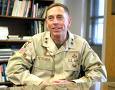 This from an interview with General Petraeus by Geraldo Rivera, discussing the success of the surge in Iraq:
GERALDO RIVERA: What was the key? I remember your very contentious report in front of Congress. There was very great skepticism about the surge. Too little, too late was the predominant criticism. What do you think was the tipping point?
GEN PETRAEUS: There have been a number of factors... The popular rejection of Al-Qaeda in Anbar was a catalyst. It gave other Iraqis an example of the fact that they could also reject this extremist form of Islam that is not Iraqi in all the violence... There is a momentum and the momemtum starts to have a positive effect.
GERALDO RIVERA: Your commanders though are suggesting that if they have not already won, they are winning the battle of Baghdad.
GEN PETRAEUS: There is no question that there has been impressive and enormous progress made in Baghdad by levels in attack, by civilian deaths, by coalition Iraqi security force casualties, you name it. There has been approvement... I would not have recommended what I did in September, if I would not have projected what we are now seeing in Iraq...
GERALDO RIVERA: You are almost acting as the only true national leader in Iraq today.
GEN PETRAEUS: This is a team effort. This is the new greatest generation of American soldier, sailor, air force, marines, coast guard and we have civilians that are out here in huge numbers as well... Our country should be very proud on the way our services have changed during the course of this.
Gateway Pundit has more plus video.
Wednesday, November 28, 2007
A Real Iraqi Benchmark
 It's axiomatic that if you want to know the true morale of a military unit, you ask the private. So hats off today to the Washington Post for doing essentially that in attempting to gauge how Iraqis themselves feel about the security situation in their county. WaPo asked Baghdad's cab drivers:
Haider Abbas, a 36-year-old taxi driver, had only a few moments to answer what is often a life-or-death question in this city: Would he drive a passenger home?
The home, on that scorching afternoon last month, happened to be in Adhamiyah, a notoriously dangerous neighborhood where several cabbies had been gunned down. Abbas hadn't been there in two years. But the fare pleaded that it had become safer, so the cabbie reluctantly agreed to go.
"To tell you the truth, I thought I had just traded my life for 5,000 dinars," or $4, said Abbas, who was shocked when he arrived in the traffic-jammed streets of Adhamiyah to see shops open and people strolling in the road. "Then I suddenly realized that security really is returning to Baghdad."
In a city where few residents believe official statements on declining violence, whether from the U.S. military or the Iraqi government, some of the most reliable figures on security improvements can be found on the odometers of Baghdad's taxi drivers.
After years of sectarian warfare whittled down the list of neighborhoods where they could safely work, cabbies are once again crisscrossing nearly all of Baghdad. Every day they assess the constantly shifting boundaries between danger and security, hoping that life will return to normal, but mindful that this is still a city where anyone could be killed at any moment for no particular reason.
. . . According to interviews with a dozen cabbies across the city, however, the mood now is far more hopeful than at any point since the February 2006 bombing of the Golden Mosque in Samarra, which plunged the country to the brink of civil war.
Abu Ahmed, 32, who lives just outside the fortresslike Green Zone, said that after the attack on the Shiite shrine, about 65 miles north of Baghdad, he could no longer drive on roads leading out of the capital. Even within the city, he said, it would have been suicide to travel to neighborhoods such as Ghazaliyah, Sholeh and Amiriyah.
"If you took a passenger to those areas," he said, "there was a good chance you would never come back."
Today, Abu Ahmed said, he takes passengers to any neighborhood in the city and any region of the country except for volatile Diyala province. "But I never go onto the side streets in the dangerous neighborhoods -- just the main roads," he said. "And sometimes I still have fear in my heart."
The office of Prime Minister Nouri al-Maliki says the number of attacks in Baghdad has plummeted from 1,442 in April to 323 last month. But instead of official pronouncements, the cabbies rely more on friends, family members, fellow drivers and what some consider a sort of innate intuition about the roads.
"We call the taxi driver in Iraq a roving reporter," said Haider Abbas, the driver who was surprised by the bustle in Adhamiyah. "We know every single neighborhood, and we can read the minds and hearts of the people who hire us."
. . . Cabbies gripe that the improved security situation also makes it harder to eke out a living. A growing number of Baghdad residents now feel comfortable driving their own cars around the city, obviating the need for taxis. The skyrocketing cost of fuel has made it harder to make ends meet. And high unemployment has led many young men to plop a yellow "TAXI" sign atop their vehicles, adding to the competition for passengers.
For taxi drivers who used to take passengers from Baghdad to Syria, the increased sense of security -- combined with strict new visa rules in Syria -- has stopped the exodus to the border, ending their source of income. . . .
Read the entire story.
Monday, November 12, 2007
Lieberman Explains The Fall of the Democrats
 Joe Lieberman catalogues the moral and ethical degeneracy of his former Democratic colleagues as they have placed the desire for political power above our national security interests. This partial transcript of Lieberman’s speech appears in today’s NY Post:
BETWEEN 2002 and 2006, there was a battle within the Democratic Party - a battle I was part of. I felt strongly that Democrats should embrace the basic framework that President Bush articulated for the War on Terror as our own - because it was our own. It was our legacy from [Presidents] Roosevelt, Truman, Kennedy and Clinton.
We could rightly criticize the Bush administration when it failed to live up to its own rhetoric or when it bungled the execution of its policies. But I felt that we should not minimize the seriousness of the threat from Islamist extremism or the fundamental rightness of the muscular, internationalist and morally self-confident response that Bush had chosen in response to it.
But that wasn't the choice most Democrats made.
Since retaking Congress in November 2006, the top foreign-policy priority of the Democratic Party has not been to expand the size of our military for the War on Terror or to strengthen our democracy-promotion efforts in the Middle East or to prevail in Afghanistan. It has been to pull our troops out of Iraq, to abandon the democratically elected government there and to hand a defeat to President Bush.
Iraq has become the singular litmus test for Democratic candidates. No Democratic presidential primary candidate today speaks of America's moral or strategic responsibility to stand with the Iraqi people against the totalitarian forces of radical Islam or of the consequences of handing a victory in Iraq to al Qaeda and Iran . . .
Even as evidence has mounted that Gen. David Petraeus' new counterinsurgency strategy is succeeding, Democrats have remained emotionally invested in a narrative of defeat and retreat in Iraq, reluctant to acknowledge the progress we are now achieving . . .
. . . There is something profoundly wrong - something that should trouble all of us - when we have elected Democratic officials who seem more worried about how the Bush administration might respond to Iran's murder of our troops than about the fact that Iran is murdering our troops.
There is likewise something profoundly wrong when we see candidates who are willing to pander to this politically paranoid, hyperpartisan sentiment in the Democratic base - even if it sends a message of weakness and division to the Iranian regime.
For me, this episode reinforces how far the Democratic Party has strayed . . .
That is why I call myself an Independent Democrat today. It is because my foreign-policy convictions are the convictions that have traditionally animated the Democratic Party - but they exist in me today independent of the Democratic Party, which has largely repudiated them. . .
Read the entire transcript here. Lieberman is an old school liberal. The only way to describe the Democratic Party today, given their elevation of rhetoric and emotion over reason and intellectual honesty, is as neo-liberals.
Subscribe to:
Posts (Atom)