Posts





Keep raising the minimum wage and business owners will either go out of business, automate, or seek alternatives to employees priced beyond the actual value of their employment. If you don't understand the concepts, Kevin Williamson provides a good primer here, written with Bernie Sanders and his supporters in mind. Regardless, you can see the impact below:
Tweet
Showing posts with label supply and demand. Show all posts
Showing posts with label supply and demand. Show all posts
Thursday, May 28, 2015
The Immutable Economic Law Of Bark & Demand

Wednesday, March 21, 2012
Supply, Demand,, Oil Speculators & An AP Hit Piece
The left is at it again, blaming oil commodity traders for the rising price of gasoline while studiously ignoring their own refusal to allow greater production of domestic oil. If you believe them, supply of oil is not the issue, just those evil speculators.
Let's ask this, do you know what the spot price was for South Carolina Intermediate Water at the close of business on NASDQ today?
There isn't one of course. Water is not traded on NASDQ, yet it is far more important to us than oil. It is necessary to sustain life. We consume exponentially more water than we do oil or gas. But because supply of water is so abundant relative to demand, it is not traded as a commodity, it is not subject to the vicissitudes of speculation in a very tight market, the cost of water in SC does not rise or fall depending on wether Iran throws a temper tantrum, and water's cost per gallon is negligible.
The moral of the story is obvious - sufficiently increase supply relative to demand, and the cost of any commodity will fall. That is the immutable law of supply and demand.
Today, we are only drilling oil in fields estimated to provide us with 22 billion barrels of oil. But what if our government opened up to drilling fields containing ten times that amount, 220,000 billion barrels of oil starting tomorrow. That is certainly within the realm of reason. Our estimated total reserves according to Obama's Department of Energy, likely exceed 3.5 trillion barrels of oil. We could easily ramp up production to the point of eclipsing Saudi Arabia as the world's largest oil producer. Indeed, we could dwarf all of OPEC. And when the daily supply of oil on the market increases markedly, what then happens to the price? Indeed, who would be willing to speculate on increasing oil prices in a saturated market with more than enough supply to meet the world's demand.
The "evil speculators" meme coming from the left is the same one the left used during the 2008 oil price explosion, when oil reached a record of $145 a barrel. By comparison, today's price is approximately $107 a barrel. The left used the meme as a red herring to cover their refusal to drill for our domestic oil. The left's 2008 complaints caused the Commodities Futures Trading Exchange and other international agencies to launch an investigation. The ultimate finding - the cause of the price spikes was not speculators, but rather that "the world economy had expanded at its fastest pace in decades, resulting in substantial increases in the demand for oil, while the oil production grew sluggishly, compounded by production shortfalls in oil-exporting countries." Supply and demand. Go figure.
The "evil speculator" meme is also a dangerous one. Commodity trading serves the purpose of insuring both producers and commercial purchasers that they will have a guaranteed contract at a set price for future production. Over regulate that and you interfere with the market - something that always comes with bad consequences. This is particularly problematic when one realizes that it is supply relative to demand that is by far the most important component of oil cost.
Update: Since writing this, I see the AP has written possibly the most deceptive piece I have ever seen. According to the AP:
MORE U.S. DRILLING DOESN'T DROP GAS PRICES
It's the political cure-all for high gas prices: Drill here, drill now. But more U.S. drilling has not changed how deeply the gas pump drills into your wallet, math and history show.
A statistical analysis of 36 years of monthly, inflation-adjusted gasoline prices and U.S. domestic oil production by The Associated Press shows no statistical correlation between how much oil comes out of U.S. wells and the price at the pump.
If more domestic oil drilling worked as politicians say, you'd now be paying about $2 a gallon for gasoline. Instead, you're paying the highest prices ever for March.
Political rhetoric about the blame over gas prices and the power to change them — whether Republican claims now or Democrats' charges four years ago — is not supported by cold, hard figures. And that's especially true about oil drilling in the U.S. More oil production in the United States does not mean consistently lower prices at the pump. . . .
. . . American oil production is about 11 percent of the world's output, so even if the U.S. were to increase its oil production by 50 percent — that is more than drilling in the Arctic, increased public-lands and offshore drilling, and the Canadian pipeline would provide — it would at most cut gas prices by 10 percent.
What a steaming pile of bull excreta that is. As Just One Minute points out:
Oh, for heaven's sake - the quetion is, does additional US production result in lower prices than would have otherwise prevailed? If, just to seize an example, producers only ramp up US production in response to shortages and rising prices elsewhere, a simple statistical analysis such as done here will "prove" that more production is always associated with higher prices.
Actually, it goes beyond even that. U.S. production has been in decline during virtually all of the past 36 years, while world demand has been steadily rising, thus making it impossible for the AP statistical analysis to have any validity. (The following numbers are given in thousands of barrels per day.) According to U.S. Energy Information Administration figures for U.S. field oil production**:
- In 1970, we were pumping 9,637 barrels of oil per day. U.S. oil production since then has STEADILY DECREASED while world demand has STEADILY INCREASED.
- In 1980, the number of barrels per day produced by the U.S. had declined to 8,597.
World demand in 1980 was 59,901.24 barrels per day.
- By 1990 U.S production had decreased to 7,355 barrels per day.
World demand had increased to 64,273.
- By 2000, U.S. production was down to 5,822.
World demand had increased to 76,963.
- In 2011, U.S. production was 5,673.
In 2011, world oil demand hit a new record of 87,400 barrels per day.
So when, over the past 36 years, has the U.S. increased its oil production so as to impact an ever increasing world demand, thus bringing down domestic gas prices? We are producing exponentially less oil today than we were in 1970, while world demand has exploded by nearly a third.
The AP article is a ludicrous agenda driven hit piece with no discernible basis in reality. THey have waterboarded statistics to tell a wholly false narrative. Indeed, even their basic premise is false. The AP compares U.S. oil production to U.S. gas prices, but that wholly mistakes the issue. There never will be a direct correlation between U.S. production and U.S. gas prices. The correlation that exists is between global production of oil - of which the U.S. has been an ever shrinking bit player - and global demand - exploding in India and China particularly over the past decade - that have been the main driver of prices. The plain truth is that we have the capability to expand oil production on a massive scale, sufficient to effect price. And I am sorry to all the lefties out there, including Obama and the AP, but they just can't repeal supply and demand.
**Note, the way the information at EIA at presented, I am unsure whether the "field oil" numbers also include our offshore oil production numbers. The offshore production numbers, in thousands of barrels of oil per day, stood relatively stable at 1,000 from 1980 to 1990, then jumped to approximately 2,000 barrels per day in 2000, where it has more or less remained since. Those numbers would cause a bit of an uptick in oil production during the period 1990 to 2000, but would still be exponentially lower than the relative increase in world demand during that same time frame. Thus it does not alter my criticism of the AP hit piece.
Tweet
Tuesday, March 20, 2012
Obama's Energy War
The left's war on energy in America has been ongoing wince the 70's. With Obama, the first truly far left President ruling our nation through the EPA, the Energy Dept. and the Dept. of the Interior, the far left's war on energy has gone into overdrive. Let's address the war on coal first, the effects of which are literally looming just around the bend. Coal accounts for nearly 50% of our electricity, but the Obama administration is just now putting in place new regulations that will begin driving coal from the marketplace. The costs of electricity will soon be ramping upwards, and the stability of our power grid will become suspect:
The Environmental Protection Agency (EPA) has dangerously underestimated the impact of its back-door mandates on affordable coal-based electricity generation. Instead of the 4.8 to 9.5 gigawatts(GW) of electric plant retirements predicted by EPA, 57 power plants with 25.1 GW of generating capacity have already gone on the chopping block due to U-MACT and CSAPR. That means more than 29,000 workers are losing their jobs, millions of consumers will be paying more for their electricity and the reliability of our electricity supply is being compromised.
U-MACT is the EPA's latest regulation on boilers. CSAPR is the EPA's recently launched Cross State Air Pollution Rule. Both are a backdoor attack on coal. Neither has or will ever be voted upon by Congress under our current wholly bastardized form of government. As I have said before, there should be No Regulation Without Representation.
As to the war on oil, Obama claims that drilling in the U.S. to increase supply will have no impact on gas prices. That is ludicrous. We are already feeling the impact of the war on oil through our gas prices - the average price of which under Obama is shown in the chart below:

Increase supply relative to demand and prices fall - that is the law of supply and demand. As to the most important component of the cost of a gallon of gas - roughly 45% - is the cost of a barrel of oil. According to Obama, we have "only 2%" of the world's oil and drilling would make no difference, we have to cut down on demand. The cognitive dissonance in that statement is mind numbing. Obama is invoking the law of supply and demand, but saying that only demand matters, not supply. Time to go to Krauthammer:
As to oil scarcity in the U.S., saying that we have only 2% of the world's oil is so deceptive that it amounts to a stunning lie of omission. What we are drilling today constitutes 2% of the world's oil. That is a minuscule fraction of what is actually in the ground in the U.S. and recoverable if Obama would allow it.
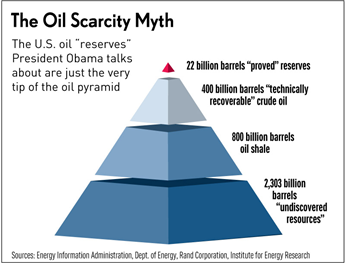
Do note that those figures come from the Dept. of Energy. As Hot Air points out, the above pyramid includes:
- At least 86 billion barrels of oil in the Outer Continental Shelf yet to be discovered
- About 24 billion barrels in shale deposits in the lower 48 states, according to EIA.
- Up to 2 billion barrels of oil in shale deposits in Alaska’s North Slope
- Up to 12 billion barrels in ANWR, according to the USGS.
- As much as 19 billion barrels in the Utah tar sands
- A stunning 1.4 trillion barrels of oil shale the massive Green River Formation in Wyoming
The reality is that the Obama administration is doing all it can to depress oil production. During the three years of the Obama administration, recovery of oil on federal lands has decreased by between 7% and 10% - and its been even worse for natural gas. Again to Krauthammer:
President Obama incessantly claims energy open-mindedness, insisting that his policy is “all of the above.” Except, of course, for drilling:
●off the Mid-Atlantic coast (as Virginia, for example, wants);
●off the Florida Gulf Coast (instead, the Castro brothers will drill near there);
●in the broader Gulf of Mexico (where drilling in 2012 is expected to drop 30 percent below pre-moratorium forecasts);
●in the Arctic National Wildlife Refuge (more than half the size of England, the drilling footprint being the size of Dulles International Airport);
●on federal lands in the Rockies (where leases are down 70 percent since Obama took office).
But the event that drove home the extent of Obama’s antipathy to nearby, abundant, available oil was his veto of the Keystone pipeline, after the most extensive environmental vetting of any pipeline in U.S. history. It gave the game away because the case for Keystone is so obvious and overwhelming. Vetoing it gratuitously prolongs our dependence on outside powers, kills thousands of shovel-ready jobs, forfeits a major strategic resource to China, damages relations with our closest ally, and sends billions of oil dollars to Hugo Chavez, Vladimir Putin and already obscenely wealthy sheiks.
Obama boasts that, on his watch, production is up and imports down. True, but truly deceptive. These increases have occurred in spite of his restrictive policies. They are the result of Clinton- and Bush-era permitting. This has been accompanied by a gold rush of natural gas production resulting from new fracking technology that has nothing at all to do with Obama.
“The American people aren’t stupid,” Obama said (Feb. 23), mocking “Drill, baby, drill.” The “only solution,” he averred in yet another major energy speech last week, is that “we start using less — that lowers the demand, prices come down.” Yet five paragraphs later he claimed that regardless of “how much oil we produce at home . . .that’s not going to set the price of gas worldwide.”
So: Decreasing U.S. demand will lower oil prices, but increasing U.S. supply will not? This is ridiculous. Either both do or neither does. Does Obama read his own speeches?
Obama says of drilling: “That’s not a plan.” Of course it’s a plan. We import nearly half of our oil, thereby exporting enormous amounts of U.S. wealth. Almost 60 percent of our trade deficit — $332 billion out of $560 billion — is shipped overseas to buy crude.
Drill here and you stanch the hemorrhage. You keep those dollars within the U.S. economy, repatriating not just wealth but jobs and denying them to foreign unfriendlies. Drilling is the single most important thing we can do to spur growth at home while strengthening our hand abroad.
Tweet
Friday, January 6, 2012
A Small Win Against The Great Biofuel Boondogle
When Congress adjourned in 2011, it did so without renewing the 45-cent-per-gallon tax credit for corn-based ethanol, nor the 54-cent-per-gallon tariff on imported ethanol. Those are two victories, but only small ones in the larger war on ending our nation's insane bio-fuels / ethanol policy. That policy pays off the politically well connected while doing immense economic harm.
The demise of the subsidy and the tariff do nothing to change the fact that demand for ethanol / bio-fuels is wholly a creation of our government. There is no market in site. It is not a question of supply meeting demand. It is a question of the government mandating ever increasing demand on one hand and subsidizing production on the other. It has been a virtual siren call for the worst of crony capitalism, waste, fraud and abuse. And as to removal of the production subsidy, that will likely only mean that we now have to pay more at the pump for E-90 (the gas to 10% ethanol mix mandated by the EPA.)
Ethanol has been around for near a century and has a legitimate use, at levels of about 5%, as an additive to gas to reduce smog in those few areas of our country where smog was historically a major problem. But around 2000, the greens made a push to recast ethanol and biofuels as actual replacements for our fossil fuels – replacements that could reduce carbon dioxide emissions and lower our dependence on foreign oil. And it was Republicans in Congress, urged on by the greens and Dems, who bit on this insanity.
It was a world class sham at the time. But that didn't stop Al Gore from cynically pushing it, nor George Bush from inexplicably signing it into law, first with the Energy Policy Act of 2005, then the Energy Independence and Security Act of 2007. Together, those laws created a requirement that all refiners mix a blend of gasoline with biofuels, setting a target known as the Renewable Fuel Standards (RFS2). The RFS2 contains mandates for different types of bio-fuels, the most important being ethanol made from corn and cellulosic biofuels made from plant scrap and non-edible plants.
So why is all of this so so so screwed. Let us count the ways:
1. Government driven ethanol production is causing massive, world wide food inflation and food shortages. Its effect falls squarely on those least able to afford it, driving well over a hundred million below the poverty line.
Corn today is being produced at or near record levels. Given normal laws of supply and demand, an increased supply would mean falling prices. U.S. corn was priced at $2 per bushel in 2006, at the start of the biofuel mandate. In just 6 years of this madness, the price has risen 225% to 7.50 a bushel today. Last year marked the first time that more corn was used to make ethanol than for any other single use, including its historic use as the primary source of feed for livestock and poultry.
As corn rises in price, so do the incredible number of foods that either contain corn products, use corn in their production, or that are indirectly effected by the switch of many farmers to a corn crop at the expense of other crops. U.S. consumers are paying the most ever for pork chops, ground beef, flour and cheese. World food costs are 68 percent higher than five years ago. That is food inflation on an insane scale. Indeed, food prices today are at their highest ever. Recently, the chief executive of one of the world's largest food producers warned that the global crisis in food production is reaching "dangerous territory" with demand outstripping supply.
While it is true that the causes for this food inflation are multiple, it is equally true that much if not most of it is due to the insane push to create "bio-fuels" out of food crops. And of course, these world record food prices are falling hardest on the poor, both at home and abroad, for whom the cost of food makes up most of their budget. The World Bank has been beating the drum on this for years, screaming to high heaven that the world's biofuel policies are driving people into extreme poverty. In 2008, the World Bank estimated that those policies had driven over 100 million people to below the povery line. Most recently was another call by the World Bank in 2011 to end the biofuel insanity:
The World Bank is calling on Governments around the world to relax laws requiring biofuels to be mixed with conventional fuels for road transport use as global food prices remain volatile.
According to the organization, rising food and fuel prices is causing unrest in some of the world’s poorest countries as more people face being pushed below the $1.25 daily income extreme poverty line.
Driven in part by higher fuel costs connected to events in the Middle East and North Africa, global food prices are 36 per cent above their levels a year ago new World Bank Group numbers released this week reveal.
The bank is calling on governments to divert more crop production away from biofuels and ease export controls to prevent even more people falling below the extreme poverty line.
“More poor people are suffering and more people could become poor because of high and volatile food prices,” said World Bank Group President Robert B. Zoellick. “We have to put food first and protect the poor and vulnerable, who spend most of their money on food.”
The World Bank says that a further 10 per cent increase in global food prices would push a further 10 million people below this line. This is in addition to the 44 million people who have been driven into poverty since last June as a result of price spikes. The World Bank estimates there are now about 1.2 billion people living below the poverty line.
To add to the point about "unrest in some of the world's poorest countries," this rise in food prices has played a major role in kicking off the recent revolutions throughout Middle East. This food price inflation is likely the single most serious problem facing our world.
But things are not going to get better, nor even stabilize. All of these problems, including the price of corn, are set to get exponentially worse as the Bush era laws and the EPA force a massive expansion of biofuel production through 2022. In 2006, Congress mandated through the RFS that 4 billion gallons of ethanol be purchased by refiners for mixing in gas. By 2008, as the economic pain RFS2 was becoming blatantly obvious, the RFS2 mandated that refiners purchase 9 billion gallons of bio-fuel to mix with gas. In 2012 the number will be 12 billion gallons of ethanol. You think we have problems now, wait til we start to get close to 2022, when Congress has mandated that refiners use 36 billion gallons of biofuel
It should also be noted that the EPA takes the position that all of this use of corn for biofuel is having a negligible impact on food prices. It is risible and, indeed, criminally false. The Competitive Enterprise Institute recently filed a complaint against the EPA asking that the EPA be required to reappraise their position on the costs of the ethanol mandates:
CEI and ActionAid filed their complaint under the federal Data Quality Act, claiming that EPA glossed over the negative human and economic impacts of its recent biofuel regulations. In fact, the complaint points out that EPA's published analysis of its ethanol mandates does not even mention resulting hunger and starvation. Moreover, the claimants attest the analysis erroneously minimizes the mandates' economic impacts.
For example, EPA predicted a decrease in world food consumption of only 0.04 percent and "a relatively modest increase in annual household food costs associated with the higher prices commanded by corn and soybeans." Yet the complaint cites a peer-reviewed study published earlier this year that found EPA's biofuel mandates have severely aggravated chronic hunger and poverty in poor areas. It estimated at least 192,000 deaths from the regulations, exceeding the World Health Organization's estimate of annual deaths from global warming by 51,000. The study concluded, "Thus, policies intended to mitigate global warming may actually have increased death and disease in developing countries."
Others have been decrying biofuel mandates since 2008 due to their human and environmental impacts. Henri Josserand of the United Nations Food and Agriculture Organization (FAO) explained food represents as much as 60 to 80 percent of consumer spending in developing countries. Drastic changes as EPA has enacted force people in those nations into extreme poverty and incite deadly food riots. South African finance minister Trevor Manuel called the mandates "criminal." Indian Finance Minister Chidambaram harshly criticized the measures, noting "in a world where there is hunger and poverty, there is no policy justification for diverting food crops towards bio-fuels."
And it is not just the rise in costs that is punishing the worlds poor. There are many horrifying anecdotal cases of poor people in third world countries having their small plots of land expropriated without compensation so that the land could be turned over to the production of biofuel crops.
2. Corn is vital not just as a food, but to food production. Yet, as of 2011, the U.S. now uses more of its corn to feed our tanks than for any other single purpose.
As noted above, 2011 marked the first time that more corn was used to make ethanol than for any other single use, including its historic use as the primary source of feed for livestock and poultry. The rise in cost of corn by 225% in just five years has wreaked havoc among livestock and poultry producers, where the major cost of bringing their animals to market is the cost of corn. The poultry industry has seen a rash of bankruptcies, including our nation's largest producer, Pilgrim's Pride, in 2008. The situation is no better in the hog industry. Smithfield CEO Larry Pope wrote in 2011, in the WSJ, that his corporation, which has only a 2 to 3% profit margin to begin with, has had to substantially downsize, closing six processing plants and a slaughter-house in an effort to minimize costs. He further discussed that he is now shrinking the size of Smithfield's packaged goods while bumping up the prices. As he concludes:
Mr. Pope says the "losers" here "are the consumer, who's going to have to pay more for the product, and the livestock farmer who's going to have to buy high-priced grain that he can't afford because he's stretching his own lines of credit. The hog farmer . . . is in jeopardy of simply going out of business 'cause he doesn't have the cash liquidity to even pay for the corn to pay for the input to raise the hog. It's a dynamic that we can't sustain."
3. Ethanol is not a viable cost effective alternative to gasoline.
As a threshold matter, even if all of the corn crop in the U.S. were given over to the production of ethanol, it would only supply 4% of our nations energy needs. It takes over 26 pounds of corn just to create one gallon of ethanol. Ethanol is highly corrosive and burns too hot for most engines to handle. Gasoline ignites at 495 F. Ethanol burns much hotter, igniting at 685 F. Indeed, the EPA has recently mandated a new mix, E-85 containing 15% ethanol, but it can only be sold for use in late model cars. Its use in older vehicles or in small engines, such as lawn mowers, will destroy the engine. The only reason the EPA is pushing this bad idea is because so much ethanol is now being mandated that E-90 will not alone be able to meet future RFS2 mandates. Thus the EPA is just going to require us to add 50% more ethanol to the mix to meed the mandates.
And on top of all those benefits, ethanol is a grossly inefficient fuel. It contains 34% less energy per unit volume than gasoline. The more ethanol in the tank, the worse gas mileage your vehicle will get.
Lastly, when one considers the indirect costs to our nation for this ethanol boon doggle, it become crystal clear that ethanol is not a cost effective substitute for gasoline. For instance, to run a single car 10,000 miles in a year on ethanol would require 11 acres of corn, enough to feed seven people for a year. And there was this itemization done last year by Zero Hedge, which still holds true today but for the 45 cent-per-gallon subsidy:
Real Cost For A Gallon Of Corn Ethanol |
|
| Corn Ethanol Futures Market quote for January 2011 Delivery | $2.46 |
| Add cost of transporting, storing and blending corn ethanol | $0.28 |
| Added cost of making gasoline that can be blended with corn ethanol | $0.09 |
| Add cost of subsidies paid to blender | $0.45 |
| Total Direct Costs per Gallon | $3.28 |
| Added cost from waste | $0.40 |
| Added cost from damage to infrastructure and user’s engine | $0.06 |
| Total Indirect Costs per Gallon | $0.46 |
| Added cost of lost energy | $1.27 |
| Added cost of food (American family of four) | $1.79 |
| Total Social Costs | $3.06 |
| Total Cost of Corn Ethanol @ 85% Blend | $6.80 |
4. Ethanol is not a "green" panacea that will protect us from carbon emissions
Ethanol was sold to America as cutting back on greenhouse gas emissions. But there are numerous studies that suggest the opposite, that the ethanol mandate actually results in the creation of more greenhouse gases when one considers not merely such gases released in the production process itself, but also changes to land use, a point most recently made in a report issued in October, 2011 by the National Academies of Science. Moreover, as the NAS makes clear, the U.S. land use restrictions do not apply in other countries, where vast swatches of rain forest are being cleared to meet the West's ethanol mandates. Even EPA studies acknowledge these facts, as explained by the WSJ in 2009:
[A study] by the Environmental Protection Agency's Office of Transportation and Air Quality . . . explains that the reduction in CO2 emissions from burning ethanol are minimal and maybe negative. Making ethanol requires new land from clearing forest and grasslands that would otherwise sequester carbon emissions. "As with petroleum based fuels," the report concludes: "GHG [greenhouse gas] emissions are associated with the conversion and combustion of bio-fuels and every year they are produced GHG emissions could be released through time if new acres are needed to produce corn or other crops for biofuels."
The EPA study also explores a series of alternative scenarios over 30 to 100 years. In some cases ethanol leads to a net reduction in carbon relative to using gasoline. But many other long-term scenarios observe a net increase in CO2 relative to burning fossil fuels. Ethanol produced in a "basic natural gas fired dry mill" will over a 30-year horizon produce "a 5% increase in GHG emissions compared to petroleum gasoline." When ethanol is produced with coal burning mills, the process "significantly worsens the lifecycle GHG impact of ethanol" creating 34% more greenhouse gases than gasoline does over 30 years.
And this doesn't even begin to consider the problems of increased water usage, increased fertilizer usage and erosion.
. . . [T]he most worrisome of recent criticisms of biofuels relate to their impacts on the natural environment. In the U.S., water shortages due to the huge volumes necessary to process grains or sugar into ethanol are not uncommon, and are amplified if these crops are irrigated. Growing corn to produce ethanol, according to a 2007 study by the U.S. National Academy of Sciences, consumes 200 times more water than the water used to process corn into ethanol.
In the cornbelt of the Upper Midwest, even more serious problem arise. Corn acreage, which expanded by over 15 percent in 2007 in response to ethanol demands, requires extensive fertilization, adding to nitrogen and phosphorus that run off into lakes and streams and eventually enter the Mississippi River watershed. . .
5. The RFS2 Mandates Force Refiners To Pay For A Non-existent Product – Cellulosic Ethanol
RFS2 mandates that refiners buy and mix biofuels in ever increasing amounts and by specific types. By 2022, the RFS2 requires that refiners purchase 36 billion gallons of biofuel, broken down into no more than 15 billion gallons of corn-based ethanol and no less than 16 billion gallons of cellulosic ethanol.
When Congress passed the Energy Independence and Security Act of 2007, they expected cellulosic ethanol to be the next great panacea. They were snorting 100% pure fairy dust.
Cellulosic ethanol is biofuel made from crop waste and non-edible plants. It is supposed to limit competition with food crops and limit greenhouse gas emissions by up to 85%. Whether any of that is true, only time will tell because, at this point, its all speculation. Despite our government throwing billions at its development since 2005 and despite mandating that refiners buy it, not a single gallon of cellulosic biofuel has yet to be commercially produced.
No one has yet figured out how to make cellulosic ethanol on a commercial scale at anything even approaching cost competitiveness. In their October, 2011 report, the National Academies of Sciences opined that oil would have to hit almost $191 a barrel and a cap and trade program or carbon tax would have to be in place before cellulosic ethanol would be cost competitive. Stating that the RFS2 is “decoupled from the costs of biofuel production and economics,” the NAS saw virtually no chance that cellulosic ethanol would be able to meet the 2022 targets set out by Congress.
(Update from Q&O quoting the NYT) There is nothing on the horizon for commercially available cellulosic ethanol in 2012:
One possible early source is the energy company Poet, a large producer of ethanol from corn kernels. The company is doing early work now on a site in Emmetsburg, Iowa, that is supposed to produce up to 25 million gallons a year of fuel alcohol beginning in 2013 from corn cobs.
And Mascoma, a company partly owned by General Motors, announced last month that it would get up to $80 million from the Energy Department to help build a plant in Kinross, Mich., that is supposed to make fuel alcohol from wood waste. Valero Energy, the oil company, and the State of Michigan are also providing funds.
Yet other cellulosic fuel efforts have faltered. A year ago, after it was offered more than $150 million in government grants, Range Fuels closed a commercial factory in Soperton, Ga., where pine chips were to be turned into fuel alcohols, because it ran into technological problems.
Nonetheless, despite all of these facts, the EPA continues to require refineries to purchase a certain amount of cellulosic ethanol for mixing each year. How can that be when the product doesn't exist?
Oil companies and fuel importers complain that the federal standards are unfair. Because cellulosic ethanol has not yet been produced commercially, refiners must buy waiver credits from the EPA to meet their obligation.
“Once again, refiners are being ordered to use a substance that no one is producing in commercial quantities — cellulosic ethanol — and are being required to pay millions of dollars for failing to use this non-existent substance,” Charlie Drevna, president of the National Petrochemicals and Refiners Association, said in a prepared statement. “This makes no sense.”
David Egner, a spokesman for the group, estimated that refiners will pay $6.8 million for cellulosic waiver credits in 2011, and if no cellulosic biofuels are produced in 2012, more than $8 million next year.
How's that for a bit of insanity. It does nothing but raise the price of gas at the pump for all Americans because EPA sets minimum purchase requirements for a non-existent product. So how does the EPA justify this?
[T]he EPA noted that the embryonic non-corn biofuels market needs an environment that encourages investment.
“In order to provide the appropriate economic conditions for the cellulosic biofuel industry to grow in accordance with the objectives of the statute, it is important that these fuels, once produced, have a viable market.,” the EPA said in its statement.
In other words, the EPA is creating a market for which there is no natural demand, for which there is no existing product, and for which there is no foreseeable circumstance where the product will be cost effective. Yet we get to pay for the privilege.
6. Whenever the government gets involved in trying to create a market for a favored product, crony capitalism, massive waste, fraud and abuse are the inevitable result.
The biofuel sector, besides its recently ended direct subsidy, gets to take part in the programs and loan guarantees that gave us Solyndra. But in at least one way, the biofuel sector is far, far more insidious. The Obama administration is using our military to create and sustain biofuel markets, irrespective of how cost inefficient this is and how dangerous it is to our national security.
Obama's Secretary of the Navy, Roy Mabus, has signed up the Navy to purchase 50% of their total fuel needs (16 million barrels) from biofuels by 2020.
The secretary of the navy reached out to prominent industry leaders during a Washington, D.C., summit Jan. 25, in an effort to have them incorporate the use of alternative fuels in their push for a clean economy.
During the Clean Energy Summit, Secretary Ray Mabus began his review of the effects converting the Department of the Navy (DoN) from fossil fuels to alternative fuels will have on the economy on a basic level.
"A clean energy economy supports American workers and creates new jobs," said Mabus. Mabus continued by trying to increase understanding of the implications of fossil-fuel by discussing our country's dependence on it. . . .
He relayed information about DoN flying an F/A-18 with a camelina-based biofuel and a MH-60 Seahawk helicopter on an algae-based biofuel. Mabus said substitutions such as this would reduce the need for altercation caused by limited availability.
"Neither feedstock impacts the food supply," said Mabus. "Camelina can be planted in rotation, and algae – well, it's grown in a pond."
Benefits of alternative fuel extend beyond the abundance of ingredients necessary for their creation. Mabus said that implementing alternative fuels will save the American people money. . .
How screwed is this? The only things Mabus should be talking about is how the Navy is going to keep the Straits of Hormuz open and how it will meet the threat of China's massive expansion into a blue water fleet. Yet here is he talking about the Navy becoming an Obama jobs program and a prop for the left's green energy mania.
Obama is in the midst of decimating our military, announcing hundreds of billions in defense cuts just today. What makes this truly dangerous – and what makes an utter mockery of Mabus's claim that this push to make the Navy green will save money – is that none of the biofuels the Navy is being forced to buy are anywhere close to cost competitive. This last month from IBD:
SolyndraGate was no isolated case of corrupt government misspending. The U.S. Navy was just forced to buy 450,000 gallons of biofuels from an Obama-connected firm at an outrageous $16 per gallon. …
Now we find the Navy partnering with the Agriculture Department to purchase hundreds of thousands of gallons of alternative biofuel in place of standard JP-5 fuel for Navy aircraft — the biggest federal purchase of biofuel ever.
It’s part of the White House’s “we can’t wait for Congress” strategy as the 2012 election year looms. But JP-5 typically costs less than $4 a gallon. . . .
As J.E. Dyer noted over the weekend on the Hot Air Green Room, “a member of Obama’s presidential transition team, T. J. Glauthier, is a ‘strategic advisor’ at Solazyme, the California company that is selling a portion of the biofuel to the Navy. Glauthier worked — shock, shock — on the energy-sector portion of the 2009 stimulus bill.”
Solazyme had already gotten a nearly $22 million chunk of change out of the taxpayers thanks to the 2009 stimulus. We heard the ludicrous excuse last week from Obama Navy Secretary Ray Mabus, as quoted in the National Journal, that “we are doing this for one simple reason: It makes us better fighters” because “our use of fossil fuels is a very real threat to our national security and to the U.S. Navy ability to protect America and project power overseas.”
What about the “very real threat” to the Navy of not having enough money for the ships, fighters and ammunition it needs to protect America? President Obama’s assault on the Pentagon could scrap 60 of the Navy’s ships, including two carrier groups.
SUMMARY
The use of food stocks for fuel has been a national and international disaster that only promises to get worse as the ethanol mandates increase through 2022. It is causing food inflation on a surreal scale and it is significantly harming livestock industries that rely on corn for feed. It is causing poverty and increasing death throughout the world. Ethanol, which is a grossly inefficient fuel source, is in no way a viable substitute for fossil fuels. It is expensive and, in terms of its green bona fides, it is at best carbon neutral. And indeed, it is doing far more harm to the environment than any environmental benefit it provides.
If ever there was a program that needs to end and end now it is the ethanol / biofuels mandates and the Defense programs to purchase massive amounts of wildly costly biofuel. It is one thing for our government to fund research and development, quite another for them to not only pick winners in the marketplace, but to create a marketplace through forced demand. Ethanol and other biofuels cannot succeed in a free market, and the government's push to create the markets are invitations to waste, abuse and crony capitalism on a grand scale.
Ethanol's total costs make it wholly inappropriate as the vehicle to reduce our dependence on foreign oil. The best way to do that is to exploit our vast domestic energy resources of oil and natural gas. End this boondoggle now.
Update: Welcome, Larwyn's Linx readers.
Monday, July 6, 2009
The Price Of Oil - NYT Mystified By Cause & Effect

The price of oil is swinging violently and trending ever upwards. The NYT is at a loss to explain it:
The extreme volatility that has gripped oil markets for the last 18 months has shown no signs of slowing down, with oil prices more than doubling since the beginning of the year despite an exceptionally weak economy.
The instability of oil and gas prices is puzzling government officials and policy analysts, who fear it could jeopardize a global recovery. . . .
A wild run on the oil markets has occurred in the last 12 months. Last summer, prices surged to a record high above $145 a barrel, driving up gasoline prices to well over $4 a gallon. As the global economy faltered, oil tumbled to $33 a barrel in December. But oil has risen 55 percent since the beginning of the year, to $70 a barrel . . .
Read the entire article. The NYT goes on to quote speculation that the instability in Nigeria and Iran are playing a significant role in the rise in oil prices, but both of those are of recent vintage and do not account for the steady upward rise in oil prices since the beginning of the year.
Anyone who couldn't see this coming is not paying attention. I wrote a month ago, in the post "The Looming Crisis In Energy Costs," that we would soon face another energy crisis. None of the causes in demand that gave rise to $145 a barrel oil have disappeared permanently. Obama has refused to live up to his promise to allow expanded exploitation and exploration of our domestic oil resources - perhaps the only thing in the near and mid-term that could actually stabilize world oil prices. And on top of that, he has, with the cap and trade bill, declared war on our energy industry, particularly on coal which provides almost 50% of our energy. This is bound to increase demand for oil. Lastly, oil is priced in dollars. A weak dollar causes higher prices for oil - and Obama is in the process of destroying the value of the dollar.
As I wrote in the above referenced post, all of these factors are clear indicators that we can expect a real crisis in oil costs. There is no reason for the NYT to be mystified by the rise in prices over the past six months. Cause and effect are clear. The NYT just needs to start some honest reporting.
Wednesday, August 27, 2008
The Democratic Convention Night 2
Bill Kristol calls in from the Pepsi Center. . . . Mark Warner was originally scheduled to speak in the 10 o'clock hour in primetime before Hillary Clinton, but Warner was moved to the less desireable pre-primetime bloc because he apparently refused to turn his speech into an attack on John McCain. . . . Hillary Rodham Clinton's most loyal delegates came to the Pepsi Center on Tuesday night looking for direction. They listened, rapt, to a 20-minute speech that many proclaimed the best she had ever delivered, hoping her words could somehow unwind a year of tension in the Democratic Party. But when Clinton stepped off the stage and the standing ovation faded into silence, many of her supporters were left with a sobering realization: Even a tremendous speech couldn't erase their frustrations.
It was the second night of the Democratic Convention with all eyes on Hillary and all thoughts on party unity. Beyond that, the speakers tonight spent an inordinate amount of time on the reoccuring theme that drilling for oil and exploiting our resources is all just an evil plot. Lastly, the keynote speaker, Gov. Warner, got demoted from his time slot for refusing to attack John McCain.
Whenever I hear Hillary speak in her incredibly grating tones, it effects me just like fingernails down a chalkboard. At any rate, her speech was the big event of the evening. It seemed a very carefully couched monologue with an eye towards 2012.
You can find the text of Ms. Clinton’s speech here. Her speech was as much if not more centered on herself than on Obama. She used her speech to paint herself into the feminist Hall of Fame. Beyond that, she listed her many policy positions, noting that Obama has the same positions.
I was listening for her to endorse Obama as having the experience necessary to be Commander in Chief and the judgment necessary to deal with our foreign policy challenges. Those are the gaping holes in Obama's resume that she so effectively exploited during the final primaries. And there is no question that those are the weaknesses hurting Obama’s campaign at the moment. But I heard none of that from her tonight. Seemingly her only message beyond self promotion was vote for Obama as better than the alternative. She said just enough to innoculate herself from any charges that she undercut Obama.
Even though Hillary mouthed the words "party unity" and stated that she now supports Obama for President, she did Obama no great favors this evening. It is an open question just how much of an impact this will have on the polls and, more particularly, on the PUMA wing of the party. My gut feeling is that it will not have a substantial impact on either.
Various other speakers spent a lot of time talking about energy policy and the futility of drilling for oil. I was amazed that they are still pushing that at this point. I hope the RNC is smart enough to make one night of the Republican convention nothing but a primer on oil and the utter fantasy being spun by the left on both supply and demand and the current cost and viability of alternative energy. We are at crunch time on energy. Failure to start the process to exploit our resources now will have potentially devestating effects on our economy years into the future.
The only other thing of note was the decision to bump Gov. Mark Warner of Virginia, out of the prime slot just before the Hillary speech. Indeed, Gov. Warner was named as the Democrat’s "keynote speaker," not simply for his oratory, but because Virginia is a key state in play this campaign. The reason for the bump – apparently Gov. Warner has some ethics. This from the blog at the Weekly Standard:
Recall that Warner was given the primetime spot because the Obama campaign expected Virginia to be in play. Now apparently they think attacking McCain is more important. A touch of panic?
Read the entire post.
And so ends Day 2. The real fun is tomorrow when former President Clinton takes the stand. I really hope he loosens up with a few martinis before that one. I really do want to hear him repeat the words "Chicago thug."
Update: According to the Washington Post, many of the PUMA's remain unconvinced:
Despite Clinton's plea for Democrats to unite, her delegates remained divided as to how they should proceed.
There was Jerry Straughan, a professor from California, who listened from his seat in the rafters and shook his head at what he considered the speech's predictability. "It's a tactic," he said. "Who knows what she really thinks? With all the missteps that have taken place, this is the only thing she could do. So, yes, I'm still bitter." . . .
Tuesday, August 19, 2008
Divorced From The Political Histrionics, NYT Discusses Oil Profits, Supply & Demand
Oil production has begun falling at all of the major Western oil companies, and they are finding it harder than ever to find new prospects even though they are awash in profits and eager to expand. Read the entire article. An even more troubling trend is the Democrats war on our oil industry. Democrats have made an industry for the past several decades of warring on capitalism. God help us, but they might win.
The Democrats are using record oil company profits to show the evils of capitalism. Obama promises to take those profits and redistribute them to the masses. It is populism at its worst and, in the reality of today, could irrevocably harm our oil industry, forcing us into even more reliance on rogue states for our energy needs. As it is, we know import 75% of our daily oil needs.
Entering the argument today is the NYT, pointing out that our oil companies are in trouble with declining production, irrespective of high profits from record oil prices. As the NYT notes, the oil companies are quite willing to invest their profits into more exploration and exploitation of new resources, but the opportunities are not available largely because governments, including the U.S., are shutting them out. The NYT also discusses the role of supply and demand in regards to both profits and the future of oil. This is a very good article. I do not know how it got by the NYT editors.
________________________________________________________
This from the NYT today:
Part of the reason is political. From the Caspian Sea to South America, Western oil companies are being squeezed out of resource-rich provinces. They are being forced to renegotiate contracts on less-favorable terms and are fighting losing battles with assertive state-owned oil companies.
And much of their production is in mature regions that are declining, like the North Sea.
The reality, experts say, is that the oil giants that once dominated the global market have lost much of their influence — and with it, their ability to increase supplies.
“This is an industry in crisis,” said Amy Myers Jaffe, the associate director of Rice University’s energy program in Houston. “It’s a crisis of leadership, a crisis of strategy and a crisis of what the future looks like for the supermajors,” a term often applied to the biggest oil companies. “They are like a deer caught in headlights. They know they have to move, but they can’t decide where to go.”
The sharp retreat in all of the commodities’ prices over the last month, about 20 percent, reflects slowing global growth and with it reduced demand for more oil in the short term. But over the next decade, the world will need more oil to satisfy developing Asian economies like China. The oil companies’ difficulties suggest that these much-needed future supplies may be hard to come by.
Oil production has failed to catch up with surging consumption in recent years, a disparity that propelled oil prices to records this year. Despite the recent decline, oil remains above $100 a barrel, unimaginable a few years ago, causing pain throughout the economy, like higher prices at the gas pump and automakers posting sizable losses.
The scope of the supply problem became more clear in the latest quarter when the five biggest publicly traded oil companies, including Exxon Mobil, said their oil output had declined by a total of 614,000 barrels a day, even as they posted $44 billion in profits. It was the steepest of five consecutive quarters of declines.
While that drop might not sound like much in a world that consumes 86 million barrels of oil each day, today’s markets are so tight that the slightest shortfalls can push up prices.
Along with mature fields, the companies have contracts with producing countries whose governments allocate fewer barrels to oil companies as prices rise.
“It has become really, really difficult to grow production,” said Paul Horsnell, an analyst at Barclays Capital. “International companies have a portfolio of assets in areas of significant decline and no frontier discoveries to make up for that.”
As a result of the industry’s troubles, energy experts do not expect oil supplies to grow this year in countries outside the Organization of the Petroleum Exporting Countries. Global demand for oil is expected to expand by 800,000 barrels a day, mostly because of rising demand in China and the Middle East, despite lower consumption in developing countries.
This imbalance between supplies and demand will be one thing that OPEC ministers will consider when they meet next month to decide whether or not to increase their production. OPEC has about 2 million barrels a day in untapped capacity that its members control.
The new oil order has been emerging for a few decades.
As late as the 1970s, Western corporations controlled well over half of the world’s oil production. These companies — Exxon Mobil, BP, Royal Dutch Shell, Chevron, ConocoPhillips, Total of France and Eni of Italy — now produce just 13 percent.
Today’s 10 largest holders of petroleum reserves are state-owned companies, like Russia’s Gazprom and Iran’s national oil company.
Sluggish supplies have prompted a cottage industry of doomsday predictions that the world’s oil production has reached a peak. But many energy experts say these “peak oil” theories are misplaced. They say the world is not running out of oil — rather, the companies that know the most about how to produce oil are running out of places to drill.
“There is still a lot of oil to develop out there, which is why we don’t call this geological peak oil, especially in places like Venezuela, Russia, Iran and Iraq,” said Arjun Murti, an energy analyst at Goldman Sachs. “What we have now is geopolitical peak oil.”
Western companies are far better than most national oil companies at finding and extracting petroleum, experts say. They have developed advanced exploration technologies and can muster significant financing to develop new fields. Many of the world’s exporting states, however, have spurned their expertise.
Oil company executives see a straightforward explanation: a trend known as resource nationalism. They contend that they have been shut out of promising regions by a rising assertiveness in the Middle East, in Russia, in South America and elsewhere by governments determined to keep full control of their oil.
Even in places where they are allowed to operate, the Western oil companies face growing problems. Countries like Russia, Algeria, Nigeria and Angola have recently sought to renegotiate their contracts with foreign investors to capture a bigger share of the profits.
“The problem with the supply side of the equation is a problem of accessing the resources in the ground so they can be explored and developed,” Rex W. Tillerson, the chairman of Exxon, said in a recent interview. “That’s a political question where governments have made choices.”
This sense of being hemmed in helps explain why the Western oil companies want more offshore drilling in the United States. They see it as one of their few options.
These companies have also tried to diversify. They have turned to natural gas as a profitable source of growth. They are tackling hydrocarbon resources, like deep-water reserves, heavy oil or tar sands. And some companies, like Shell and BP, are investing in renewable fuels.
Unquestionably, the oil companies could have done more. They failed to invest heavily in exploration after the oil-price collapse of the mid-1980s, which lasted through the 1990s.
In 1994, the top five oil companies spent 3 percent of their free cash on share buybacks and 15 percent on exploration. By 2007, they were spending 34 percent of their free cash on buybacks — in effect, propping up their share prices — and a mere 6 percent on exploration, according to figures compiled by a team led by Ms. Jaffe and Ronald Soligo of Rice University. As a result, some experts warn that supplies will fall short of the demand over the next decade, perhaps sending prices well above today’s levels.
At a recent conference in Madrid, Christophe de Margerie, the chief executive of the French company Total, said the world would be hard-pressed to raise supplies beyond 95 million barrels a day by 2020. Only a few years ago, forecasters expected 120 million barrels a day by 2030, a level many analysts now view as unrealistic.
The major companies picked up their capital spending around 2005, although much of the increase has been offset by the soaring cost of development. Exxon, for example, expects to spend about $25 billion annually for the next three years to expand its business, compared with $15 billion a year from 2002 through 2006.
“It’s amazing the difference from the 1970s, where a lot of money went into exploration, development and production of new resources,” said Paul Stevens, a senior research fellow at Chatham House, a London policy research organization. “It is happening a little bit now, but it is not going to be enough.”
As the power and clout of Western companies erode, the world may become increasingly dependent on government-controlled entities for oil.
While some may be up to the task, like Saudi Aramco, others, like Petróleos de Venezuela, suffer from bureaucratic inefficiencies and political interference.
“We are going to depend on the Venezuelan, the Nigerian or the Iranian oil companies for the future of our oil supplies,” said Bruce Bullock, the director of the energy institute at Southern Methodist University. “This is a troubling trend.”
Tuesday, August 5, 2008
Part III: Why Exploit Our Domestic Oil Resources
Oil Shale – 800,000,000,000 – 2,000,000,000,000 barrels of oil How fast any of these assets could be brought on line is an issue. In some places, such as off the coast of California where drilling was halted three decades ago but some of the rigging is still in place, I have seen an estimate of one year though I can’t find the link now. As to ANWR, given that the drilling site has already been fully explored, most estimates show production becoming available in one to three years from start of drilling. The estimates of yield are 1,000,000 barrels of oil per day. As to the others, there still has to be exploration and ten years is probably a reasonable estimate. All of this assumes that drilling, even if approved, is not sidetracked by over-regulation and by private lawsuits brought under the EPA and ESA - all of which is discussed in Part II, above. Explanation: Methodology: Retail gasoline prices are the result of literally hundreds of factors including crude oil supply, global demand, refinery capacity, regulation, taxes, weather, the value of the dollar, etc. Therefore it is impossible to say with certainty what one individual action will do to the overall price. However, based on what we know about the impact of crude oil supply and prices it is possible to develop some potential ranges of impact on gasoline prices for certain policy changes. For example, using the methodology employed by Speaker Pelosi and House Democrats that suspending shipments into the Strategic Petroleum Reserve (between 40-77,000 barrels of oil a day) would reduce gas prices by at least 5 cents, bringing ANWR online (at least one million barrels of oil a day) could impact gasoline prices by between 70 cents and $1.60. On the Democratic side, there are two sets of figures to look at. The first comes from Charles Schumer. On the floor of the Senate, he stated a month ago that an increase in world supply of 1,000,000 barrels per day would immediately drop the price of oil by fifty cents. That was part of his call to somehow force Saudi Arabia to begin pumping an extra million barrels of oil per day. The second set of figures also comes from Senator Shumer. Apparently it is only if that oil is produced in Saudi Arabia would it impact the price of gas under the well worn rules of supply and demand. A million barrels of additional production from domestic sources would, according to Senator Schumer and essentially all of his Democratic colleagues, have nominal, if any impact on gas prices.
How does $300 a barrel oil in a decade strike you? That is the prediction of T. Boone Pickens, the billionaire octogenarian oil man, unless things change. His prior prognostications on the oil market have proven accurate over the years.
It does not take a PhD in economics to recognize that supply and demand is at the heart of the rising cost of oil – although if you wish to rely on an economist Thomas Sowell would be a good one to consult. [As an aside, the exchange rate of the dollar adds between 15% to 20% to the cost of a barrel of oil today over the exchange rate in 2000, but that is beyond the scope of this post.]. Because supply has stagnated while demand has risen, we are getting hit from two sides. One, the base price of oil is going to continuously rise with rising demand. Further, demand looks to trend ever upward for the forseeable future. Two, because the market is tight with demand at or exceeding supply, it will remain volatile, subject to high fluctuations, if there is any significant threat to supply, whether it be a threat from God, Gaia or man.
__________________________________________________________
Note: This is the third in a series of posts looking at our energy alternatives.
Part I – The Economics of Alternative Energy - an examination of the viability and cost effectiveness of wind, solar, geo-thermal, bio-mass, bio-fuel, and nuclear.
Part II - Oil & The Hostile Domestic Regulatory Environment - a look at the regulatory scheme put in place since 1970 that prohibits or otherwise limits our ability to exploit our domestic oil and natural gas.
As to demand, it has exploded. The rise in demand has varied from country to country, but worldwide it increased 15% in the 1990’s and has already increased 10% from 2000 to 2005. Much of that comes from China which is now importing about 4 million barrels of oil per day. That is 60% of its oil supplies and over four times the oil it was importing just 8 years ago. India’s figures, though lower, are growing at a similar percentage rate. And these economies are just starting to expand. World wide demand is going to grow.
Supply was able to roughly match demand through 2004. World oil production stagnated in 2005 and has not kept pace with this explosion in demand since. Thus, we get what some cynically call the Pelosi premium as markets adjusted post-2005 to the new supply and demand equation: (From Freep via Gateway Pundit)
New sources of oil need to be found, but as the major oil fields play out, these are expected to be more expensive to exploit. That said, they do exist to be exploited, particularly in the U.S. where we are sitting on possibly trillions of barrels of reserves between ANWR, coastal sites and oil shale.
So what is our supply and what effect would that have on demand and the price of gas at the pump?
Estimates of recoverable oil from our domestic resources currently off-limits to exploration or drilling include the following:
Continental Shelf (East & West Coast) – 115,000,000,000 barrels of oil
ANWR – 10,000,000,000 barrels of oil
What would this increase in supply mean to oil and gas prices?
Using Republican figures, this would at least bring the cost of gas down to about $2.00 per gallon. Here was the basis for their assessment.
Here is the explanation of the above chart from Congressman Roy Blunt:
Someone is being less than honest with America. And given that two thirds of voters now favor expanded domestic drilling, I’d say the jury has reached a verdict on who is telling the truth.
Eventually, and the sooner the better, we need to move off of oil. The writing is on the wall, and unlike the 70’s and 80’s when the impetus to find cost effective alternative energy was overcome by the Saudis flooding the markets with cheap oil, I can’t see this one going away. The Saudis are producing near capacity already and demand is going to continue to rise. Even fully exploiting our own resources is only going to buy us time to develop alternatives. But, as I explained in detail in Part I linked above, alternative energy simply is not yet developed to the point that they can be substituted for oil and gas. Thus, not exploiting our oil resources in the absence of viable and cost effective alternatives is a recipe for economic disaster. While Obama may welcome high gas prices, Middle America is just beginning to suffer and our economic figures will eventually begin to show the pain.
Thursday, July 10, 2008
Drilling Is A Hoax? She Is Certifiable
Does this woman have any credibility whatsoever? Or sanity, for that matter?
Republicans are the cause?
Where does this idiot want us to believe oil comes from? Oh, that's right. It was her idea to sue OPEC so that they could (drill) magically create more oil and we could transfer more wealth to OPEC. Powerline has an excellent video on how that one is working out for us -
At any rate:
(H/T Michelle Malkin)
That graph is a bit of snark. Democrats did not cause the energy crisis. But by pretending supply and demand is meaningless, they are rapidly going to come to own it. They are going to own it by their utter refusal to allow drilling where we KNOW that there there is oil (as opposed to the 69 million acres under exploration that will, statistically, only yield economically feasible wells less than 20% of the time). They are going to own it because of their refusal to allow us to exploit oil shale, and they are going to own it because of the entire host of other regulation they have thrown up to prevent the development of our oil resources and the development of nuclear power. We need to be approaching the energy crisis through a lot of different approaches - such as those suggested by both McCain and T. Boone Pickens - but it damn well needs to include drilling and it needs to start now.
[Update: Some appropriate cartoon commentary from Michael Ramirez:]
Just as an aside, to review Pelosi's time as the third most powerful person in the U.S. government, she to this day claims al Qaeda was not in Iraq, she schemed to legislate surrender in Iraq, she visited Syria, she refused to allow the Patriot Act to come to a vote for months, her promises to clean up earmarks and corruption have gone virtually nowhere, and now she is claiming that the law of supply and demand is a mere Republican dirty trick. This woman is a clear and present danger to America. The U.S. will be a much better place when the nightmare that is Nancy Pelosi is no longer in a position of power.
Monday, June 30, 2008
Interesting Posts From Around The Web - 1 July 2008
Slapstick Politics hosts a guest blogger who was particularly impressed by the precision of Scalia’s opinion in Heller. It is well worth a read to savor the taste of the seminal originalist opinion of our time. Iraq, Afghanistan, War & the Military Thunder Run has a superb roll-up from mil-blogs and other war related news. Oil & Economics From Markedmanner, oil hit another all-time high today. Supply is so tight that any problem with any large producer causes a big jump in the futures contracts. That combined with the weak dollar is causing tremendous problems. Obama Discriminations post on former Secretary of State Lawrence Eagleburger who compares Obama’s pre-emptive race bomb with the tactics he observed from Joe McCarthy. Socialism Down under at a Western Heart, a good essay that takes a stab at defining the various classes of socialists and the left. Republicans Matt at Weapons of Mass Discussion questions the efficacy of donating to the National Republican Senatorial Committee. Their strategy is apparently to hide their affiliation and run against McCain. Who dreamed up this strategy, Howard Dean? Global Warming Aurora reports from down under that Kevin Rudd is preparing to tank Australia’s economy in the name of global warming. Read the post. It sounds quite dire. UK & Europe Blue Crab Boulevard blogs on political correctness gone absolutely stark raving bonkers in Sweden. Israel Soccer Dad has an exceptional post on the proposed deal to trade Samir Kuntar to Hezbollah for the remains of two dead Israeli soldiers. Angel at Woman, Honor Thy Self believes PM Olmert is foolish to make a trade of a terrorist who murdered a child for the remains of two Israeli soldiers. Solomnia is troubled by the same issue. Islam Ironic Surrealism has a chilling highlight reel from the film "Suicide Killers", by Pierre Rehov – a documentary at the culture, ideology and tactics that go into the making of Islamist suicide bombers. History A great post with lots of links of Pre-WWII Americana and more at the Irish Elk. Entertainment Under the Hill has a movie review of Wall-E. They love it. Humor Lot’s of oil. No Caribou. Looks like a great place for exploratory drilling – from Power and Control.
The most interesting posts from around the web, all below the fold . . .
__________________________________________________________
Art: The Declaration of Independence, John Trumbull
Second Amendment
As Transterrestrial Musings points out, a lot of people who support a robust Second Amendment right will pulling the lever for McCain in November. The reason – as I also pointed out here - an Obama presidency will likely see the Heller decision rendered a nullity. Power and Control thinks likewise.
Meryl Yourish is exercising her Second Amendment rights after the Heller decision.
Soob blogs on the thought process of gun control advocates, as demonstrated in the Fox News panel Sunday morning. Meanwhile, the Educated Shoprat blogs a case study in the practical benefits of a robust Second Amendment.
Carl at No Oil For Pacifists has a great post on the whining and lamentations of the left in the wake of the Heller opinion. The whine that really gets me comes from those who claim the 1939 Miller case was precedent for holding that the Second Amendment did not grant an individual right. The only people who can possibly spout such nonsense and believe it are people who have never read the case and have no understanding of the law.
In the UK, from whom we inherited the Second Amendment right, the Adam Smith organization ponders the erosion of their own rights.
Bizzyblog wonders how the media will spin the lowest two month death total for U.S. forces in Iraq from all causes since the invasion of Iraq in 2003.
Seven years after 9-11, the war on terror has been a great success on all major fronts. Four Right Wing Whackos have the new Dem line: "Success against the Taleban. Enemy giving way in Iraq. Al-Qaeda on the run. Situation dire. Let's retreat!"
A great quote from John Adams posted at Power and Control.
A very good post from Callimachus giving his thoughts on the reality of war, total war, and the costs of finding war too brutal to fight to win.
On Jan. 5, Lance Cpl. Robert Crutchfield, home on leave, was shot in front of his girlfriend during a mugging and later died. Red Alerts is following the story and posts that the two thugs who committed this crime will face the death penalty.
From This Ain’t Hell, Dems latest attempts to tie the explosion in oil prices to some highly nebulous Bush big oil agenda. It does not seem to be working. Kollarow is blogging on polls showing the vast majority of Americans favor drill for oil offshore and in ANWR. Even 40% of Democrats are starting to think that a rig or two in ANWR is sounding pretty good. From Pam Meister, Drill Here, Drill Now. Freedom Now ponders our oil woes and Democratic obstructionism – not only at home, it seems, but abroad also.
Matt at Weapons of Mass Discussion has a great blog addressing the canard repeated ad infinitum concerning there is no need to lift the moratorium on ANWR, offshore drilling or the exploration of oil shale when "Big Oil needs to drill in the 68 million acres they already have leased."
Eye on the World posts that Obama tosses Wessley Clark under the bus after Clark’s unconscionable comments on McCain’s service to our country yesterday. Clark is pure ambition unsaddled with ethics.
Comments Confederate Yankee, the saddest thing about Obama’s military experience is that "the only person he knows with the experience of getting a bomb on target is Bill Ayers."
Jammie Wearing Fool notes the new Democratic talking point: "so McCain was tortured, big deal." These people have a deficit of class matched by their deficit of sense. Gay Patriot also weighs in, and then notes "The more attacks I see from the left the more convinced I become that theirs is a party of hate." In truth, the default position for an increasing majority on the left is not to argue issues, but to demonize those whom they do not agree with. I think "party of hate" only scratches the surface.
Obama supports equal pay for women, just not in his campaign staff – per the Jawa Report.
Vocal Minority posts on Larry Elder, a black conservative, who responded to a query from a fellow African American. Elder explains in detail why he is supporting McCain over Obama. It makes for a good read.
Joshua Pundit posts on Iraq’s decision to sue the UN over the oil for food program – and there is an Obama connection.
Are Obama trolls gaming Google to get anti-Obama blogs shut down? It appears that way. The Irate Nation has the story. The Anchoress also blogs this, along with other stories.
See the Samizdata quote of the day, and then this on the triumph of collectivism in the U.S. and Europe.
I concur with Stop the ACLU that unions are no longer of benefit to our nation. The benefits unions provided to America ended long ago when the worst of employer abuses likewise ended. And with that thought in mind, please note that full and accurate information is the very coin of democracy – and literally so when it concerns the taxpayers coin. Apparently, unions in Washington do not see it that way.
Insanity in the UK posted by Dhimmiwatch. The UK is about to deport a Pakistani family that converted to Christianity even though they face a threat of death for that in their home country. This as the UK hosts a rogues gallery of the world’s worst terrorists that they cannot deport for precisely the same reason. Meanwhile, Shield of Achilles blogs on another honor killing of a young girl in the UK.
In the Netherlands, charges dropped by prosecutors against Geert Wilders for insulting Islam. Dinah Lord posts that the decision included the finding that the legislator's comments were part of a legitimate debate. That debate does not extend to the utterly ludicrous UN Human Rights Council which will now, per Europe News, entertain no discussion of Islam. Anyone who does not realize that this is an existential conflict isn’t paying attention.
Seraphic Secret has an articulate and chilling post on "jew hating savages of Paris" and wherein he makes the point that "Jews are the canaries in the coal mine of civilization."
Political InSecurity posts that MI-5 is warning that al Qaeda is planning suicide attacks in the UK using NHS ambulances.
From LGF - According to the study "Imams in Germany," up to 20 percent of preachers belong to the more conservative, fundamentalist strand of Islam. The study also discovered that only one fifth of imam’s possess academic qualifications."
IslamistWatch posts that surgical hymen restoration – i.e., to present as a virgin – are the rage in Europe among Muslim women. And it is on the welfare dime in the UK and Denmark because the women face threats of violence if they are not virgins when married.
Islam In Europe posts a comprehensive round-up of Islamist related news occurring in Europe.
RightTruth posts on a fascinating book by John Press, Culturalism. It poses the opposite of the insane doctrine of multiculturalism. "Culturism holds that majority cultures have a right to define, protect and promote themselves. By that light, preventing the building of mega-mosques is a reasonable culturist policy. Multiculturalism holds that all cultures are the same and that Britain has no core culture. That is obvious rubbish. Then they use the word racism to slander anyone who does not agree. Culturism is a word that can combat the abuse of Western nations with the words multiculturalism and racism." You could also call it common sense.
Dutchblog Israel posts on the slow diminution of democracy as violence by Islamists comes to be seen as a justifiable method of political expression.
To call what is going on in the UK a decline in academic standards at the hands of the socialist Labour government is a grotesque understatement. MK has the story.
Dave in Boca has a fascinating post with a lot of personal insights on the al Dura affair and the circle the wagons irrespective of the facts approach being taken by the French media to protect a reporter who should be jailed for life for the bloodshed he has caused.
And see Shrinkwrapped’s exceptional essay on the al Dura affair and its reverberations. "The parallels between the Al-Dura blood libel and the Haditha slander suggest that the American elites are coming to closely resemble the Israeli elites in their ready acceptance of guilt and their aesthenic reactions to accusations of evil intent and atrocity against those who protect us."
A new Holocaust – only this one aimed at Christians in Muslim lands. Persevere has the story and links. DhimmiWatch has the story of the religiously motivated kidnapping and torture of Coptic Christians and Churches in Egypt. Christians Under Attack has the story of state discrimination against Christians in a province in Indonesia and attacks against converted Christians in Iran as the state ponders whether to start executing converts again.
Verum Serum reports on a Saudi marriage officiant who says that there is no minimum age for marriage – you can marry as young as one year old - though the groom should wait a few years before sexual intercourse. The Dhivehistan, a Maldives blog, posts on two pre-pubescent child brides in Yemen who have run away and both filed for divorce. In fairness to Yemen, this is a major story who many in the country are hoping will lead to a reexamination of the practice. The problem is that the Koran records the 50+ year old prophet taking a 6 year old bride and then having sex with her when she was 9.
At the Whited Sepulchre, a memo from a Jihadist Safety Consultant. It is hilarious.
From FireBase America, the Italians are fighting back. Compare that with a day in the life of a French Police Officer at the Covenant Zone.
Sake White has posted on the Islamic slave trade – a trade which has lasted over 14 centuries and, in some areas, continues today.
From Gates of Vienna: "Peace-loving Muslims have been made irrelevant by their silence. Peace-loving Muslims will become our enemy if they don’t speak up, because like my friend from Germany, they will awaken one day and find that the fanatics own them, and the end of their world will have begun."
The Truth posts on the decision of the Canadian HRC to dismiss charges against Mark Steyn and Muslim unhappiness therewith.
The American Jingoist blogs on the shaky legal ground on which stands the Virginia Islamic Academy.
Elder of Ziyon posts on some real tin foil hat level paranoia – this time of the Persian variety.
Politics & Pigskins salutes the passing of George Carlin. At Blogs of War, Carlin doing his 7 Words You Can’t Say On Television routine.
D.C. Comics has revived Catwoman – with a spin. She is now a lesbian. Deansworld comments on the likelihood of success of this new marketing ploy.
Heh – KG has the New Zealand Navy.
The good folk at Vast Right Wing Conspiracy have felt the muse and been moved by Obama to write new lyrics for an old song, Hey, Hey, Hey, Another One Under The Bus . . .

Subscribe to:
Posts (Atom)